Thermal Analysis in Automotive Materials: Enabling Better Material Understanding and Quality Control
The automotive industry relies on thousands of components made from a wide range of materials. While vehicle structures vary depending on power systems and applications, modern automobiles are generally composed of four major systems: powertrain, chassis, body, and electrical systems.
Among the many materials used in traditional automotive manufacturing, thermoplastic polymers, thermosetting resins, and rubber materials play a critical role. They are widely applied in:
✅ Interior components
✅ Exterior parts
✅ Sealing systems
✅ Tires and rubber components
✅ Lightweight automotive structures
To ensure material performance, reliability, and process consistency, thermal analysis technologies such as DSC (Differential Scanning Calorimetry) and TGA (Thermogravimetric Analysis) have become essential tools in automotive material research, development, and quality control.
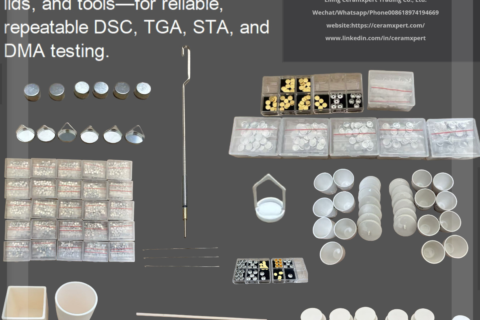
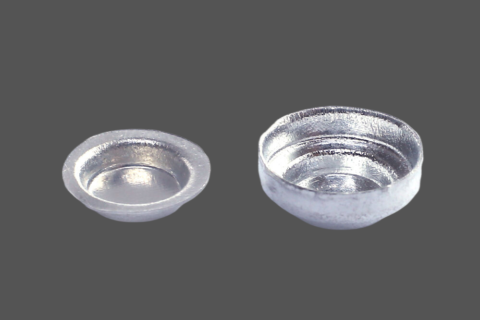
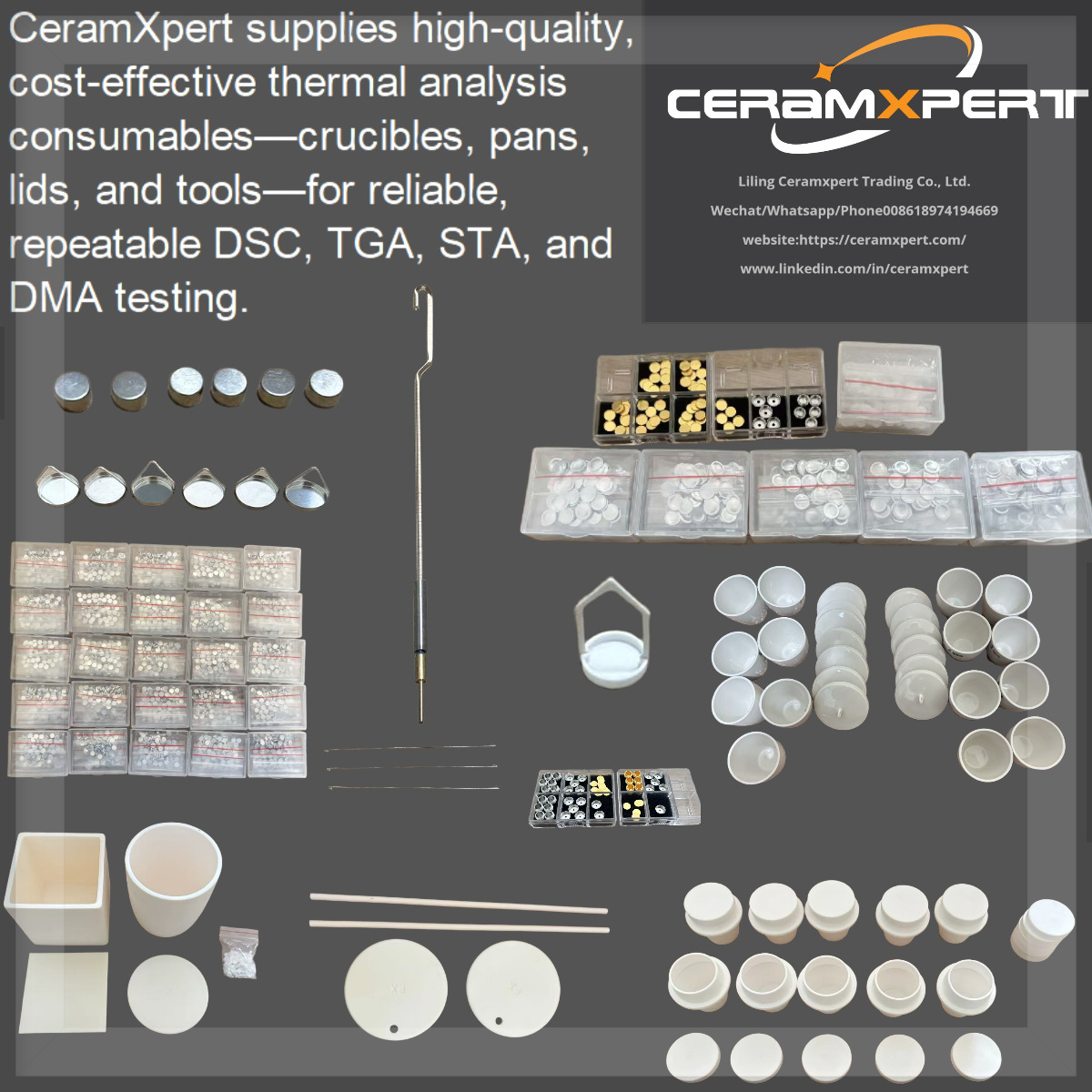
At CeramXpert, we provide high-quality thermal analysis consumables, including crucibles, sample pans, and accessories compatible with leading thermal analysis instruments, helping laboratories achieve reliable and repeatable testing results.
Case Study 1: Identifying Polymer Types and Estimating Composition Using DSC
PC/ABS blends are widely used in automotive interiors, especially for applications such as instrument panels and structural components. This thermoplastic alloy combines the excellent properties of:
- Polycarbonate (PC) – high impact strength and heat resistance
- Acrylonitrile Butadiene Styrene (ABS) – good processability and toughness
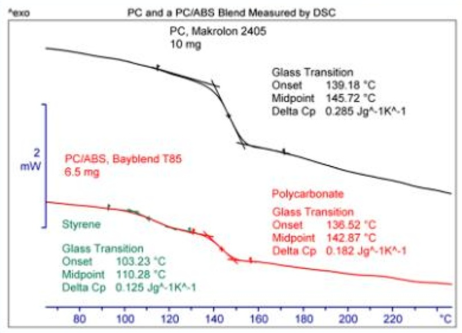
Because PC and ABS remain as separate phases in the blend, they exhibit different glass transition temperatures (Tg), allowing DSC analysis to identify polymer components.
In one DSC study:
- Pure PC showed a Tg of approximately 145.7°C
- PC/ABS blend showed two Tg values:
- ABS phase: 110.3°C
- PC phase: 142.9°C
The shift of Tg values compared with pure materials confirms the presence of both polymer phases.
Furthermore, DSC can estimate component ratios through heat capacity changes (ΔCp):
- ΔCp of PC in PC/ABS blend: 0.182 J/g·K
- ΔCp of pure PC: 0.285 J/g·K
The calculated PC content was approximately 64%.
Application value:
DSC provides a fast and effective method for polymer identification, composition analysis, and incoming material verification in automotive manufacturing.
Case Study 2: Evaluating the Degree of Cure of Thermosetting Materials
Epoxy resins are widely used in automotive applications as:
- Adhesives
- Protective coatings
- Lightweight composite materials
Their final performance depends strongly on the crosslinking process during curing.
Using DSC, we can evaluate curing behavior by comparing samples cured at 150°C for different durations.
During the first heating cycle:
- Tg gradually increased with longer curing time
- The residual curing exothermic peak decreased
This indicates that longer curing time results in a higher degree of crosslinking.
Even after 140 minutes of curing at 150°C, a small residual curing peak remained, indicating that the epoxy system was not completely cured.
After the second heating cycle:
- Tg stabilized around 110°C
- No additional curing peak was observed
This confirms that the material became fully cured after the first heating process.
Application value:
DSC analysis helps optimize curing temperature and time, improving the performance and reliability of automotive composite materials.
Case Study 3: Determining Rubber Composition Using TGA
Rubber materials are widely used in vehicles due to their excellent elasticity and recovery properties.
Common automotive rubber applications include:
- Tires
- Sealing systems
- Vibration isolation components
- Protective parts
To improve rubber performance:
- Oils are added as plasticizers to reduce hardness
- Carbon black is added to improve strength and wear resistance
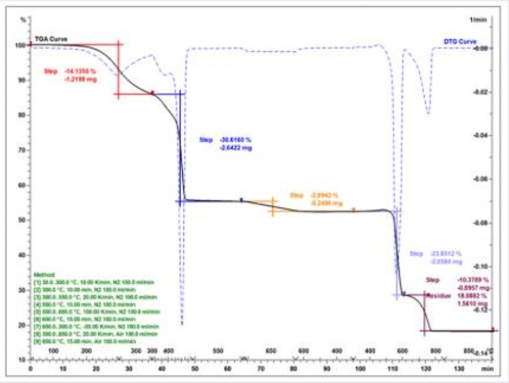
TGA provides a rapid method to quantify rubber components.
For certain rubber systems containing acrylonitrile or halogen elements, thermal decomposition can generate pyrolytic carbon, which may interfere with carbon black measurement.
By applying a controlled atmosphere switching method:
- Nitrogen atmosphere
- Volatile components and oils decompose
- Rubber polymer degradation occurs
- Switching to an air atmosphere
- Pyrolytic carbon decomposes first
- Added carbon black, which decomposes at higher temperatures
This allows accurate separation and quantification of carbon black content.
In one example based on GB/T 14837.2-2014, the carbon black content in halogen-containing rubber was determined to be approximately:
10.38%
Application value:
TGA enables fast composition analysis and supports rubber formulation optimization for automotive applications.
Why Thermal Analysis Matters for Automotive Materials
For automotive material developers and quality control teams, thermal analysis provides valuable information, including:
✔ Glass transition temperature (Tg)
✔ Melting and crystallization behavior
✔ Polymer identification
✔ Component ratio estimation
✔ Degree of cure
✔ Rubber composition analysis
✔ Thermal stability evaluation
These insights help manufacturers:
- Improve material selection
- Optimize processing conditions
- Ensure product consistency
- Accelerate R&D development
- Enhance automotive component reliability
CeramXpert: Supporting Reliable Thermal Analysis Testing
At CeramXpert, we specialize in manufacturing high-performance thermal analysis consumables for DSC, TGA, and other thermal characterization techniques.
Our products include:
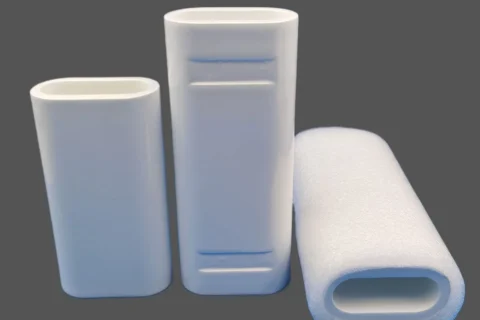
🔹 Alumina crucibles
🔹 Platinum sample pans
🔹 Sapphire crucibles
🔹 High-temperature ceramic consumables
🔹 Customized solutions for thermal analysis instruments
Compatible with major brands including TA Instruments, Netzsch, Mettler Toledo, PerkinElmer, Setaram, Hitachi, and Leco, CeramXpert helps laboratories achieve accurate and repeatable thermal analysis results.
For automotive materials research, polymer development, rubber analysis, and quality control, reliable consumables are an essential part of reliable data.
#CeramXpert #ThermalAnalysis #DSC #TGA #AutomotiveMaterials #PolymerAnalysis #MaterialsScience #AutomotiveEngineering #PolymerCharacterization #RubberAnalysis #EpoxyResin #QualityControl #MaterialTesting #AdvancedMaterials #LaboratorySolutions #ThermalAnalysisConsumables #Ceramics #RAndD