🔬 DSC Thermal Analysis of Perovskite Materials for Solar Cell Applications
DSC Thermal Analysis of Perovskite Materials for Solar Cell Applications
Perovskite materials have attracted significant attention in the field of next-generation solar cells due to their excellent optoelectronic properties, high absorption efficiency, and potential for improving photovoltaic device performance.
Understanding the thermal properties of perovskite materials is essential for improving material stability, processing conditions, and long-term device reliability.
Differential Scanning Calorimetry (DSC) is one of the most commonly used techniques for studying thermal transitions, including the glass transition temperature (Tg), which reflects the transformation of a material from a glassy state to a more flexible state. Tg is closely related to molecular structure, segmental mobility, and material stability.
In this experiment, DSC was used to investigate the thermal behavior of perovskite materials through a heating–cooling–heating cycle and determine the glass transition temperature.
🧪 DSC Heating–Cooling–Heating Test Procedure for Perovskite Materials
1. Sample Preparation
✅ Drying treatment
- Perovskite powder samples were dried in a vacuum oven at 80°C for 12 hours to remove absorbed moisture and minimize interference during DSC testing.
✅ Sample grinding
- The dried samples were finely ground to achieve uniform particle size (<50 μm), ensuring consistent heat transfer during measurement.
2. DSC Instrument Calibration
Before testing:
- High-purity indium (In) standard material was used for temperature calibration.
- A sapphire standard sample was used for heat flow calibration.
This ensures accurate thermal measurement and reliable DSC curves.
🔥 DSC Testing Process
First Heating Cycle: Room Temperature → 450°C
- Heating rate: 10°C/min
- Removes residual solvents and volatile components.
- Promotes structural stabilization of the perovskite material.
- A broad endothermic peak may appear, related to thermal desorption and phase transition behavior.
Cooling Cycle: 450°C → 200°C
- Cooling rate: 10°C/min
- The sample transforms from a high-temperature disordered state toward a lower-temperature glassy state.
- Nitrogen atmosphere protection is maintained to minimize degradation.
Second Heating Cycle: 200°C → 450°C
- The DSC curve records thermal transitions during reheating.
- The glass transition temperature (Tg) can be calculated through tangent analysis.
📌 Example result:
Tg ≈ 325.5°C
This value provides important information for evaluating the thermal stability and processing conditions of perovskite materials.
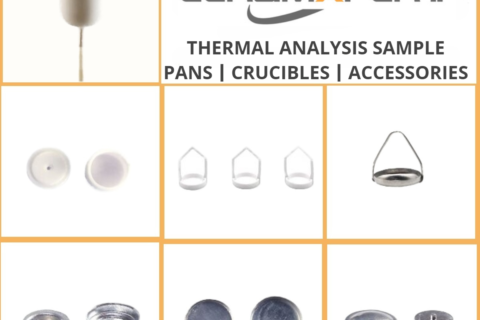
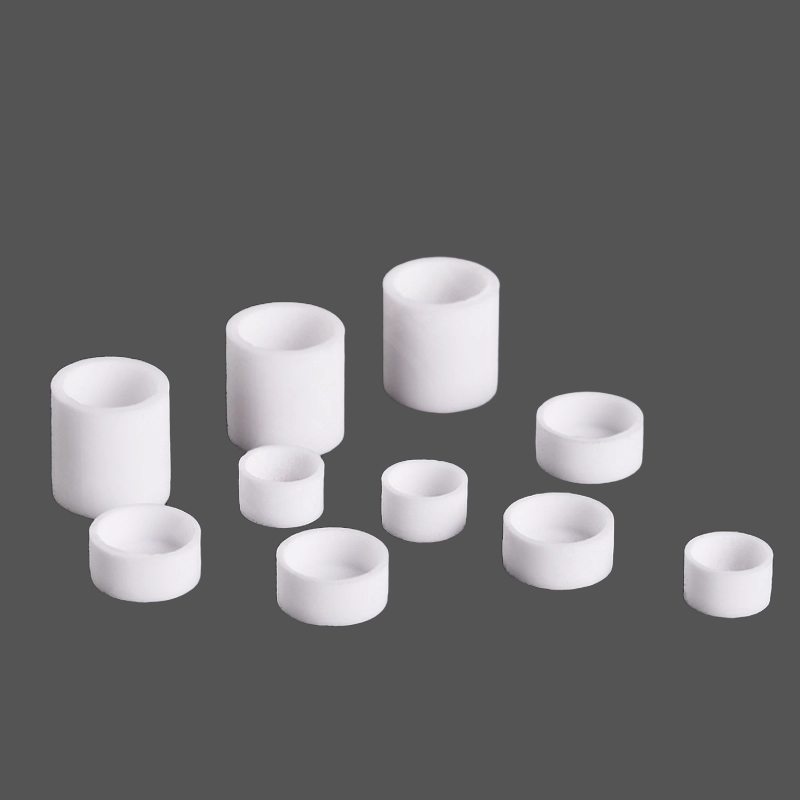
🏭 CeramXpert Thermal Analysis Crucibles for Perovskite DSC Testing
Reliable DSC results depend not only on the instrument but also on the quality and compatibility of the sample crucible.
CeramXpert provides high-performance thermal analysis crucibles designed for demanding applications, including:
✔ Perovskite materials
✔ Solar cell research
✔ Battery materials
✔ Polymers
✔ Ceramics
✔ Metallurgy
✔ Chemical analysis
⭐ Recommended Crucible Solutions
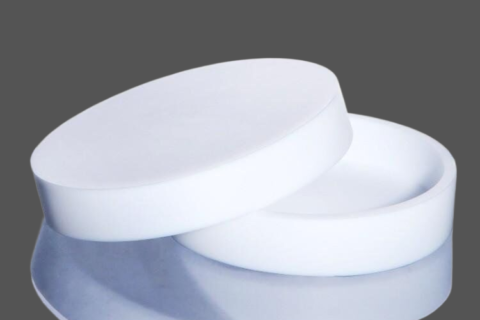
1. Boron Nitride (BN) Crucibles — Premium Choice for High-Temperature DSC
Advantages:
✅ Excellent thermal stability at elevated temperatures
BN crucibles maintain structural integrity during repeated thermal cycles.
✅ Outstanding chemical inertness
BN does not easily react with perovskite materials, reducing contamination risks and protecting sample purity.
✅ Smooth non-stick surface
Helps prevent sample adhesion, reduces sample loss, and allows easy cleaning after testing.
✅ High-density hot-pressed structure
Improves mechanical strength and minimizes cracking during repeated heating cycles.
Customization options:
- Shallow dish design for improved heat transfer
- Lid design for controlled atmosphere experiments
- Customized dimensions according to DSC/TGA instrument models
2. 99% Alumina (Al₂O₃) Crucibles — Cost-Effective Laboratory Solution
For routine thermal analysis applications:
✅ Good mechanical strength
✅ Excellent chemical resistance
✅ Stable performance at 450°C testing conditions
✅ Suitable for regular DSC/TGA laboratory testing
🔬 Why Choose CeramXpert Thermal Analysis Crucibles?
At CeramXpert, every batch of thermal analysis crucibles undergoes strict quality control, including:
✔ Thermal stability testing
✔ Chemical resistance evaluation
✔ Dimensional inspection
✔ Performance verification
Our goal is to provide reliable and compatible consumables for researchers, universities, and industrial laboratories worldwide.
Whether you are working with DSC, TGA, STA, or other thermal analysis techniques, CeramXpert offers customized ceramic solutions to support accurate and repeatable testing results.
🌐 Learn more about our thermal analysis consumables and advanced ceramic solutions:
https://ceramxpert.com/
#CeramXpert #ThermalAnalysis #DSC #DifferentialScanningCalorimetry #PerovskiteMaterials #PerovskiteSolarCells #SolarCellResearch #BatteryMaterials #MaterialsScience #AdvancedCeramics #BoronNitride #BNCrucible #AluminaCrucible #TGA #STA #LaboratoryConsumables #MaterialCharacterization #ResearchAndDevelopment #UniversityResearch #ChemicalAnalysis #CeramicSolutions #HighTemperatureMaterials #AnalyticalChemistry