
OEM vs. Compatible Thermal Analysis Consumables: 6 Things Every Laboratory Should Check
Is an OEM consumable always the only reliable choice? Or can a compatible alternative meet the technical requirements of your laboratory?
For laboratories working with Differential Scanning Calorimetry (DSC), Thermogravimetric Analysis (TGA), and Simultaneous Thermal Analysis (STA), this is more than a purchasing question. It is a decision involving measurement reliability, method consistency, equipment compatibility, quality assurance, and operating costs.
OEM consumables are designed and supplied for specific instrument platforms. Compatible alternatives, when properly specified and evaluated, may offer laboratories another sourcing option.
However, a lower purchase price or a familiar-looking design does not automatically make a product suitable.
The important question is not simply whether a consumable fits the instrument. It is whether it meets the technical and quality requirements of the intended application.
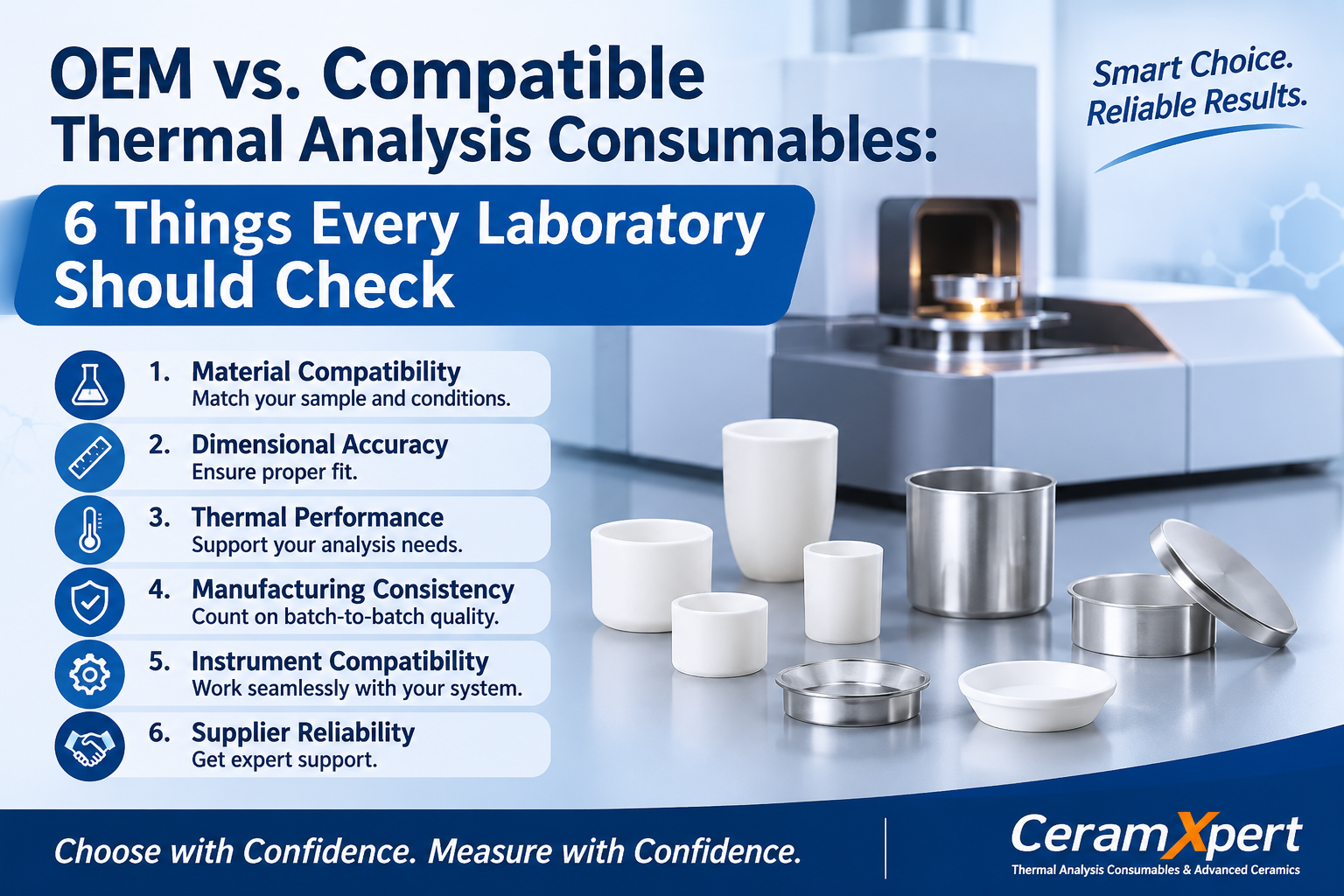
Before choosing between OEM and compatible thermal analysis consumables, every laboratory should check these six factors.
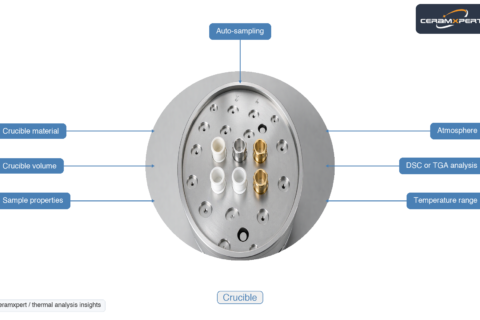
1. Instrument Compatibility: Does It Fit Beyond the Part Number?
The first step is confirming compatibility with the actual instrument and sample-handling system.
A compatible consumable should be evaluated against the relevant specifications, including:
- Instrument manufacturer and model.
- Original reference or part number.
- External and internal dimensions.
- Sample carrier and sensor configuration.
- Lid design and sealing requirements.
- Compatibility with automatic sample changers, where applicable.
A product may have similar external dimensions but still differ in important details, such as bottom geometry, wall thickness, rim design, or lid fit.
These differences may affect positioning, handling, sealing, or thermal contact.
What laboratories should check:
Do not rely on a part number or product photograph alone. Request dimensional specifications and confirm compatibility with the exact instrument model and application.
2. Material Composition and Purity: Is It Suitable for Your Sample?
Material selection is one of the most important considerations in thermal analysis.
Different materials have different thermal, chemical, and mechanical characteristics.
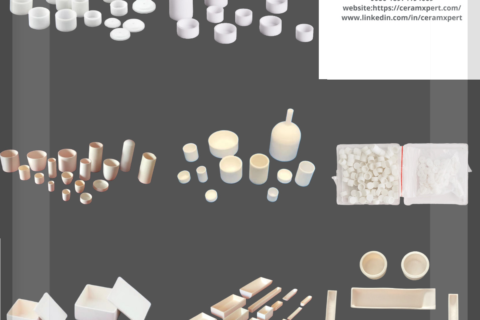
Common examples include:
- Aluminum: Frequently used for routine DSC measurements because of its favorable thermal conductivity and low thermal mass, within its applicable temperature range.
- Alumina (Al₂O₃): Widely used in high-temperature TGA applications because of its thermal stability and suitability for many sample systems.
- Platinum: Used in selected applications where its thermal properties and chemical compatibility are appropriate.
- Zirconia (ZrO₂): Considered for specialized applications requiring particular high-temperature and material characteristics.
However, identifying the material alone is not enough.
Laboratories should also consider material purity, possible impurities, chemical interactions, and the operating atmosphere.
For example, a crucible that performs well with one sample may react with another. Certain sample compositions may also attack or contaminate the crucible during heating.
What laboratories should check:
Ask for the material grade, purity information where relevant, recommended temperature range, and chemical compatibility guidance.
The material must be suitable for the complete experimental conditions—not just the maximum temperature stated in a catalogue.
3. Dimensional Accuracy and Manufacturing Consistency: Are Products Consistent from Batch to Batch?
In thermal analysis, small differences in consumable specifications can matter.
For DSC, variations in crucible mass, bottom flatness, and geometry may influence thermal contact and measurement response.
For TGA, dimensional consistency, sample capacity, and crucible stability are important considerations for repeatable sample handling and measurement conditions.
Laboratories should pay particular attention to:
- External diameter and height.
- Internal volume and wall thickness.
- Bottom flatness and surface finish.
- Crucible mass and mass variation.
- Lid dimensions and fitting accuracy.
- Manufacturing tolerances.
Two products may look identical but have different manufacturing tolerances.
Likewise, a product that meets specifications in one production batch should maintain those specifications in subsequent batches.
What laboratories should check:
Request dimensional drawings, tolerance information, and batch-to-batch quality-control details.
For applications requiring high sensitivity, mass consistency and dimensional precision deserve particular attention.
4. Thermal Performance and Measurement Reproducibility: Does It Perform Under Your Test Conditions?
Physical compatibility is only part of the evaluation.
A consumable must also perform appropriately under the laboratory’s actual measurement conditions.
Relevant parameters may include:
- Heat transfer and thermal contact.
- Thermal mass and heat capacity.
- Temperature stability.
- Sample-to-crucible interaction.
- Gas exchange and atmosphere exposure.
- Background signal and measurement reproducibility.
For DSC, differences in crucible material, mass, and geometry may influence the thermal response and peak characteristics.
For TGA, the crucible must remain suitable for the intended temperature and atmosphere without introducing unwanted mass changes or sample interactions.
It is important to recognize that the observed measurement response is influenced by the entire experimental system, including the instrument, calibration, sample preparation, heating program, atmosphere, and consumables.
Therefore, no alternative should be assumed to produce identical results simply because it has similar dimensions or specifications.
What laboratories should check:
Evaluate the alternative using representative samples, reference materials, blank measurements, and repeated runs under the laboratory’s established procedures.
Compare relevant parameters such as baseline behavior, peak temperature, enthalpy where applicable, mass change, and measurement repeatability.
Acceptance criteria should be defined according to the intended application.
5. Lid Design, Sealing, and Operating Safety: Is the Configuration Appropriate?
The lid is not merely an accessory. Its design can influence gas exchange, sample retention, and pressure development during an experiment.
Depending on the application, laboratories may require:
- Open crucibles.
- Loose-fitting lids.
- Pierced lids.
- Hermetically sealed crucibles.
- Specialized high-pressure crucibles.
These configurations are not interchangeable.
For example, open or pierced configurations may be appropriate when gas exchange or the release of volatile products is required.
Hermetically sealed crucibles may be suitable for specific DSC investigations involving volatile components, liquids, or moisture-sensitive samples, provided the temperature and pressure limitations are respected.
High-pressure applications require particular care. A conventional hermetic DSC pan should never be treated as equivalent to a pressure-rated crucible.
What laboratories should check:
Confirm the intended sealing configuration, compatible sealing tools, maximum operating conditions, and pressure rating where applicable.
For safety-critical thermal analysis, especially thermal hazard assessment, use only appropriately rated equipment and follow the validated method and relevant safety procedures. Do not substitute a pressure-rated vessel based solely on dimensional similarity.
6. Quality Assurance, Traceability, and Supplier Support: Can the Supplier Demonstrate Consistent Quality?
A competitive quotation is important, but reliable supply requires more than an attractive price.
Laboratories should understand how a supplier controls product quality and manages consistency over time.
Consider asking:
- Are product specifications clearly documented?
- Is material information available?
- Are dimensional inspections performed?
- Are production batches subject to quality checks?
- Can the supplier provide relevant inspection records or certificates when required?
- Can the supplier maintain consistent specifications for repeat orders?
- Is technical support available when compatibility questions arise?
Supplier communication also matters.
A reliable supplier should be able to discuss the intended application, identify the relevant product specifications, clarify limitations, and respond to technical questions.
What laboratories should check:
Evaluate the supplier’s documentation, quality-control process, communication, and ability to support repeat orders—not just the quoted unit price.
How Should a Laboratory Evaluate a Compatible Alternative?
A practical evaluation process can help reduce uncertainty before changing suppliers.
We recommend the following approach:
Step 1 — Define the application
Identify the instrument model, consumable reference, sample type, temperature range, atmosphere, and measurement method.
Step 2 — Compare technical specifications
Review material, dimensions, tolerances, mass, volume, lid configuration, and operating limitations.
Step 3 — Request supporting documentation
Obtain available technical drawings, material specifications, inspection information, and relevant quality records.
Step 4 — Conduct a controlled comparison
Where appropriate, compare the alternative with the laboratory’s established consumable using blank runs, reference materials, representative samples, and replicate measurements.
Step 5 — Establish acceptance criteria
Determine whether the alternative meets the laboratory’s requirements for measurement performance, repeatability, handling, and quality control.
Step 6 — Monitor ongoing consistency
After approval, continue monitoring product quality and measurement performance across subsequent batches and repeat orders.
The objective is not to change suppliers simply to reduce purchasing costs. It is to identify a technically suitable and dependable sourcing option.
OEM or Compatible: Which Is the Better Choice?
There is no universal answer.
OEM consumables may be the preferred choice when a laboratory requires a specific manufacturer-supplied product, established documentation, or a validated configuration.
Compatible alternatives may be worth evaluating when laboratories want additional sourcing flexibility, competitive pricing, or another supply option for routine applications.
The decision should be based on:
- Technical suitability.
- Documented specifications.
- Application-specific performance.
- Quality consistency.
- Supplier reliability.
- Total operating cost.
The most economical choice is not necessarily the product with the lowest unit price. It is the product that meets the laboratory’s requirements consistently and reliably.
How CeramXpert Approaches Compatible Thermal Analysis Consumables
At CeramXpert, we believe that compatibility should be supported by technical specifications and application understanding—not simply by a matching product number.
We provide cost-effective compatible alternatives for thermal analysis consumables used with instruments from:
Mettler Toledo | NETZSCH | PerkinElmer | TA Instruments | Hitachi/Seiko | LECO | Setaram | Shimadzu | Linseis | Rigaku and other manufacturers.
Our product range includes:
- Aluminum DSC pans and lids.
- Alumina and zirconia crucibles.
- Platinum crucibles and specialized containers.
- TGA sample holders and accessories.
- Crucible sealing tools and related consumables.
- Customized advanced ceramic components.
We are a trading and distribution company based in China, focused on supplying compatible alternatives and customized ceramic products. Our products are not OEM products, and references to original manufacturers or part numbers are provided for compatibility identification only. CeramXpert is not affiliated with those manufacturers.
Our approach is straightforward: understand the application, clarify the specifications, and identify a suitable product for evaluation.
A Question for Laboratory Professionals
When evaluating compatible thermal analysis consumables, which factor has the greatest influence on your purchasing decision?
- Technical specifications and instrument compatibility?
- Material quality and measurement reproducibility?
- Quality documentation and supplier reliability?
- Cost savings and supply flexibility?
We welcome your experience and professional insights in the comments.
CeramXpert | Thermal Analysis Consumables & Advanced Ceramics
🌐 Website: https://ceramxpert.com/
✉️ Email: max@ceramxpert.com
#ThermalAnalysis #DSC #TGA #STA #LaboratoryConsumables #MaterialsScience #LaboratoryQuality #QualityControl #AdvancedCeramics #CeramXpert