
Choosing the Right Crucible for High-Temperature TGA Applications
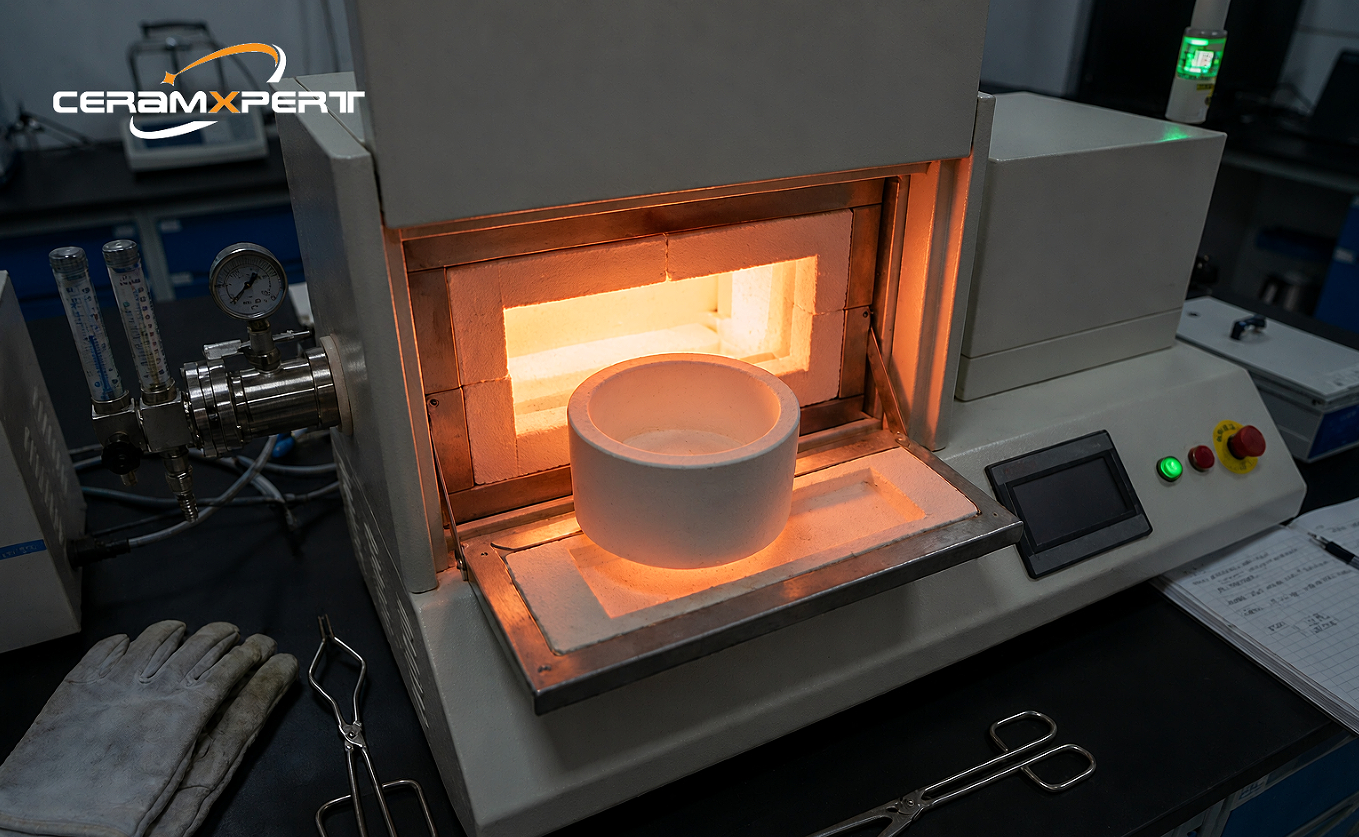
Alumina, Zirconia, Platinum, and How to Decide
By CeramXpert — advanced ceramics and thermal analysis consumables
Explore alumina, zirconia, platinum and other crucible materials according to temperature, atmosphere and sample chemistry — and find out where high-temperature alumina and zirconia crucibles deliver the best value for your lab.
Quick answer: what is the best crucible for high-temperature TGA?
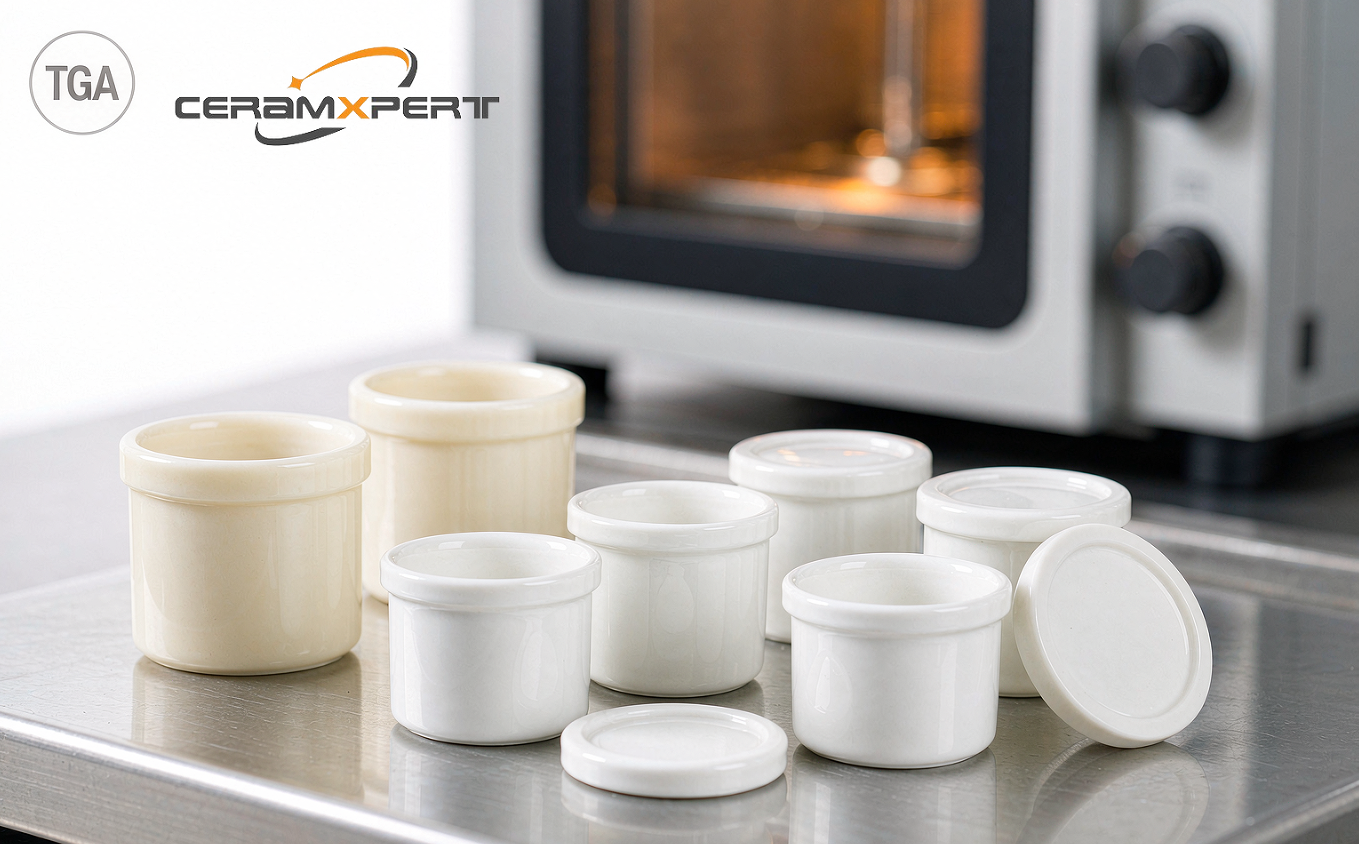
For most high-temperature TGA work above ~600 °C, a 99% high-purity alumina crucible is the right default: chemically inert with the vast majority of samples, stable in both oxidising and inert atmospheres, reusable, and rated for continuous use to roughly 1600 °C. Choose platinum when you need maximum thermal conductivity or near-zero contamination, and yttria-stabilised zirconia when you are pushing beyond alumina’s temperature range or running aggressive alkali fluxes. In every case, confirm the crucible’s outside diameter and height fit your instrument’s holder before you buy.
Why the crucible changes your TGA data
Thermogravimetric analysis measures tiny changes in sample mass as temperature rises. Anything the crucible contributes — a reaction with the sample, a mass change of its own, uneven heat transfer — appears directly in your curve as error.
That is why crucible selection for TGA is stricter than for general furnace work. A pan that is perfectly fine for ashing can be exactly wrong for a mass-loss experiment.
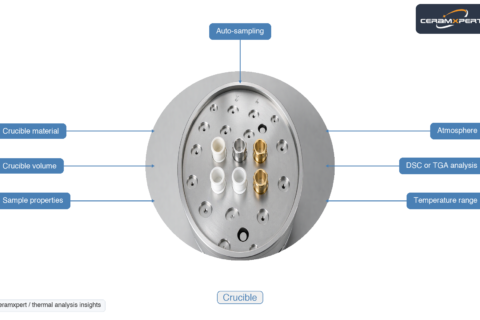
Three questions decide nearly every selection:
- Material — will it stay inert with your sample at your working temperature?
- Volume and lid — does it suit your sample mass, and do you need gas exchange or containment?
- Instrument fit — will it sit correctly in your holder and balance?
Answer them in that order, and most bad runs become avoidable.
Material comparison: alumina vs zirconia vs platinum and more
| Crucible material | Practical upper temperature | Atmosphere | Key strength | Main limitation |
| 99% high-purity alumina (Al₂O₃) | ~1600 °C continuous (some grades to 1700–1800 °C) | Air, O₂, N₂, Ar, vacuum | Chemically inert with most samples; reusable; low background signal | Attacked by molten alkali fluxes |
| Yttria-stabilised zirconia | Specialist high-temperature use, typically above 1600 °C (grade-dependent) | Oxidising, inert | Better resistance to aggressive alkalis and fluxes than alumina; very hard | Higher cost; confirm exact rating for your grade |
| Platinum (Pt) | ~1200–1600 °C in routine thermal analysis (metal melts at 1768 °C) | Air, inert (avoid reducing conditions) | Best thermal conductivity; excellent Cp performance; near-zero contamination | Expensive; alloys with Pb, Bi, Si, P; attacked by samples that reduce to free metal |
| Sapphire | >1600 °C | Air, inert | Single-crystal purity; suitable for melting Fe, Ni and other metals | Very high cost |
| Graphite | Up to ~2000 °C and beyond in inert/reducing gas | Inert only | Excellent conductivity at extreme temperature | Oxidises in air above roughly 700–800 °C |
| Quartz (SiO₂) | ~1100 °C | Air, vacuum | High purity; excellent thermal shock resistance | Softens well below TGA temperatures; attacked by alkalis |
| Aluminium pan | ~600 °C | Air, inert | Low cost, fast thermal response | Low-temperature DSC only — not for high-temperature TGA |
The practical default: if your work is routine polymers, minerals, pharmaceuticals, ceramics or catalysts, 99% alumina covers it. Reach for another material only when temperature or chemistry genuinely pushes past alumina’s limits.
Atmosphere: the variable people forget
The furnace gas reacts with both sample and crucible. Match them deliberately.
| Atmosphere | Alumina | Platinum | Graphite |
| Oxidising (air / O₂) | Stable — the routine TGA default | Stable | Not usable — burns in air |
| Inert (N₂ / Ar) | Stable — easy default | Stable | Usable |
| Reducing / reactive gas evolution | Generally stable | Caution: metal-reducing samples can attack Pt | Usable, but verify sample chemistry |
For oxidation studies, use an open or pierced lid so the gas reaches the sample freely. For decomposition work where spattering or re-condensation is the problem, a loose or closer-fitting lid improves reproducibility. Decide whether your run is gas-exchange-limited or loss-limited — then choose the lid.
Match the crucible to the sample chemistry
- Polymers and plastics — alumina, open or pierced lid; air for oxidation studies, nitrogen for pyrolysis.
- Minerals, ceramics and inorganics — alumina; its ~1600 °C rating covers calcination and loss-on-ignition work.
- Pharmaceuticals and organics — alumina for TGA; thin aluminium pans only for low-temperature DSC below ~600 °C.
- Catalysts and carbons — alumina under a controlled atmosphere. Never run graphite in air.
- Metals and alloys — alumina or zirconia is usually safer. Check for alloying: molten metals can destroy a platinum crucible.
- Aggressive fluxes and strong alkalis — do not use alumina. Switch to zirconia or platinum.
Three combinations cause a predictable failure every time: graphite in air, platinum with metal-reducing samples, and alumina with alkali fluxes.
Volume, fill level and instrument fit
Volume. TGA crucibles commonly run from about 25 µL to several hundred µL. Smaller volumes heat faster and more uniformly, giving better resolution for small samples; larger volumes suit bulky or low-density material.
Fill level. Fill to no more than about two-thirds. Overfilled crucibles let the sample creep, spit or bridge to the lid and corrupt the mass signal. Keep sample mass and fill height consistent between runs — reproducible geometry gives reproducible curves.
Instrument compatibility. This is the most common mistake in the whole process: the right material in the wrong size. Netzsch, Mettler Toledo, PerkinElmer, TA Instruments, Hitachi/Seiko and Leco holders each have specific diameters, heights and base profiles. Confirm outside diameter, height and bottom geometry against your instrument before ordering.
Five small mistakes that quietly ruin TGA curves
- Working too close to the temperature rating. Leave headroom below ~1600 °C; long holds at the limit invite creep and drift.
- Overfilling. Keep to about two-thirds maximum.
- Skipping conditioning. Fire a new crucible empty once at working temperature to stabilise the surface and burn off residues.
- Scraping crucibles clean. Mechanical cleaning damages the surface and sheds particles. Re-fire instead.
- Inconsistent sample geometry. Standardise mass, fill level, and ramp rate so curves can be compared.
Where the opportunity is: high-temperature alumina and zirconia crucibles
TGA crucibles are consumables. They accumulate residue, get damaged and get replaced — so unit cost matters over a year of running samples, and it matters without any excuse to compromise data quality.
That is why high-temperature alumina crucibles are the commercial sweet spot for most labs. A 99% alumina part made to the same dimensions and purity as an OEM crucible delivers the same inertness, the same temperature rating and the same fit — without the brand premium. And when the chemistry turns aggressive or the temperature climbs past alumina’s range, zirconia crucibles are the natural upgrade rather than an automatic jump to platinum.
At CeramXpert, we supply high-quality, cost-effective thermal analysis consumables — high-temperature alumina and zirconia crucibles, sample pans, carriers and accessories — compatible with Mettler Toledo, Netzsch, PerkinElmer, TA Instruments, Hitachi/Seiko, Rigaku, Setaram, Shimadzu, Linseis and Leco instruments. Standard sizes cover routine TGA, DSC and STA work, and custom dimensions can be made when a holder or method demands it.
Our position is simple: consistent crucibles = credible data, and you should not pay a premium for a consumable when precision engineering and the right ceramic grade will do the job.
If you are reviewing your TGA consumables this quarter, start with two questions: are your alumina crucibles rated for your actual working temperature, and do you have a zirconia option ready for the samples alumina cannot handle?
FAQ: high-temperature TGA crucible selection
What is the best crucible material for high-temperature TGA? For most applications, 99% high-purity alumina — inert with most samples, reusable and rated to about 1600 °C. Use platinum or yttria-stabilised zirconia only for higher temperatures or aggressive chemistry.
When should I choose zirconia instead of alumina? When your method runs above alumina’s practical range, or when the sample involves aggressive alkali fluxes that corrode alumina. Zirconia is the specialist ceramic for these cases; confirm the exact temperature rating for the grade you buy.
Is platinum worth the cost for TGA? Only when contamination cannot be tolerated — trace-level gravimetric work, Cp determination or methods that specify platinum. It is expensive and can alloy with certain metals or fail under reducing conditions.
Can graphite crucibles be used in air? No. Graphite oxidises in air above roughly 700–800 °C. It is only suitable in inert or reducing atmospheres.
How full should a TGA crucible be? No more than about two-thirds, with consistent sample mass and fill height between runs.
Are third-party alumina crucibles as good as OEM ones? If the dimensions, purity and flatness match, yes — same inertness, same temperature rating, same fit, lower cost. The critical step is verifying compatibility with your instrument holder.
The takeaway
Choosing a crucible for high-temperature TGA comes down to three decisions: material, volume and lid, and instrument fit. Alumina is the default, zirconia is the high-temperature / aggressive-chemistry specialist, and platinum earns its price only in the cases that truly demand it. Get those decisions right, and your curves get cleaner, your runs get repeatable, and your consumable spend gets smarter.
CeramXpert — precision ceramics for thermal analysis. Let’s connect and explore how the right crucible can support your work.
#CeramXpert #TGA #ThermalAnalysis #AluminaCrucible #ZirconiaCrucible #HighTemperatureTGA #PlatinumCrucible #LabConsumables #MaterialsScience #AdvancedCeramics #LabEfficiency