Alumina Tubes: Key Factors to Consider for High-Temperature & Laboratory Applications
CeramXpert – Advanced Ceramic & Thermal Analysis Consumables
Alumina tubes are widely used in high-temperature furnaces, laboratory research, semiconductor processing, and chemical engineering applications due to their excellent thermal stability, mechanical strength, and chemical resistance.
At CeramXpert, we supply high-purity alumina tubes designed for demanding environments where precision and reliability are critical.
Why Alumina Tubes Matter in Modern Industry
Made primarily from Al₂O₃ (aluminium oxide), alumina tubes are engineered for environments where metals and polymers fail. Their unique combination of:
- High-temperature resistance
- Excellent electrical insulation
- Superior chemical corrosion resistance
- High mechanical strength
makes them essential in thermal analysis, furnace systems, R&D labs, and industrial processing equipment.
Key Factors When Choosing Alumina Tubes
Selecting the right alumina tube is not just about size—it directly impacts performance, safety, and service life.
1. Maximum Operating Temperature
Different purity levels (95%–99.7% Al₂O₃) determine thermal limits.
- Standard alumina: up to ~1400°C
- High-purity alumina (≥99.5%): up to 1600°C or higher
At CeramXpert, we help match tube grade with your actual working temperature to prevent cracking, deformation, or failure.
2. Thermal Shock Resistance (Rapid Temperature Changes)
If your application involves fast heating or cooling cycles, thermal shock resistance is critical.
Key considerations:
- Wall thickness (thinner = better shock resistance)
- Grain structure (fine grain improves stability)
- Heating/cooling rate control
CeramXpert alumina tubes are engineered for stable performance under repeated thermal cycling conditions.
3. Application Environment & Function
Understanding how the tube is used is essential for correct selection:
- Furnace liners or protection tubes
- Wire or thermocouple insulation
- Chemical transport or reaction environments
- Semiconductor or vacuum systems
Each application requires a different tolerance for heat, pressure, and chemical exposure.
4. Chemical Compatibility
Alumina is highly inert, but certain environments (strong alkalis or extreme corrosive flux conditions) may require higher purity or alternative ceramics such as zirconia or boron nitride, also available from CeramXpert.
5. Dimensional Accuracy & Mechanical Strength
Precision is critical for laboratory and industrial integration.
Consider:
- Inner/outer diameter tolerance
- Straightness
- Surface finish
- Load-bearing strength
CeramXpert provides both standard and customised alumina tube dimensions for OEM and research needs.
FAQ – Alumina Tube Selection Guide (CeramXpert)
🔹 What is your maximum operating temperature?
Our alumina tubes typically withstand:
- Up to 1400°C for standard grades
- Up to 1600°C+ for high-purity alumina (≥99.5%)
The exact limit depends on application conditions such as atmosphere, heating rate, and mechanical load.
🔹 Are you dealing with rapid temperature changes (thermal cycling)?
If yes, we recommend:
- Thin-wall alumina tubes
- Fine-grain high-purity alumina
- Controlled heating/cooling rates
CeramXpert can help optimise material selection to improve thermal shock resistance and extend service life.
🔹 What is the tube being used for (e.g., furnace, wire insulation, or chemical transport)?
This is one of the most important selection factors:
- Furnace applications → high-density, high-purity alumina
- Wire/thermocouple insulation → precision small-diameter tubes
- Chemical systems → corrosion-resistant alumina or alternative ceramics
- High-vacuum or semiconductor use → ultra-high purity, low-porosity alumina
CeramXpert provides application-based material matching to ensure optimal performance.
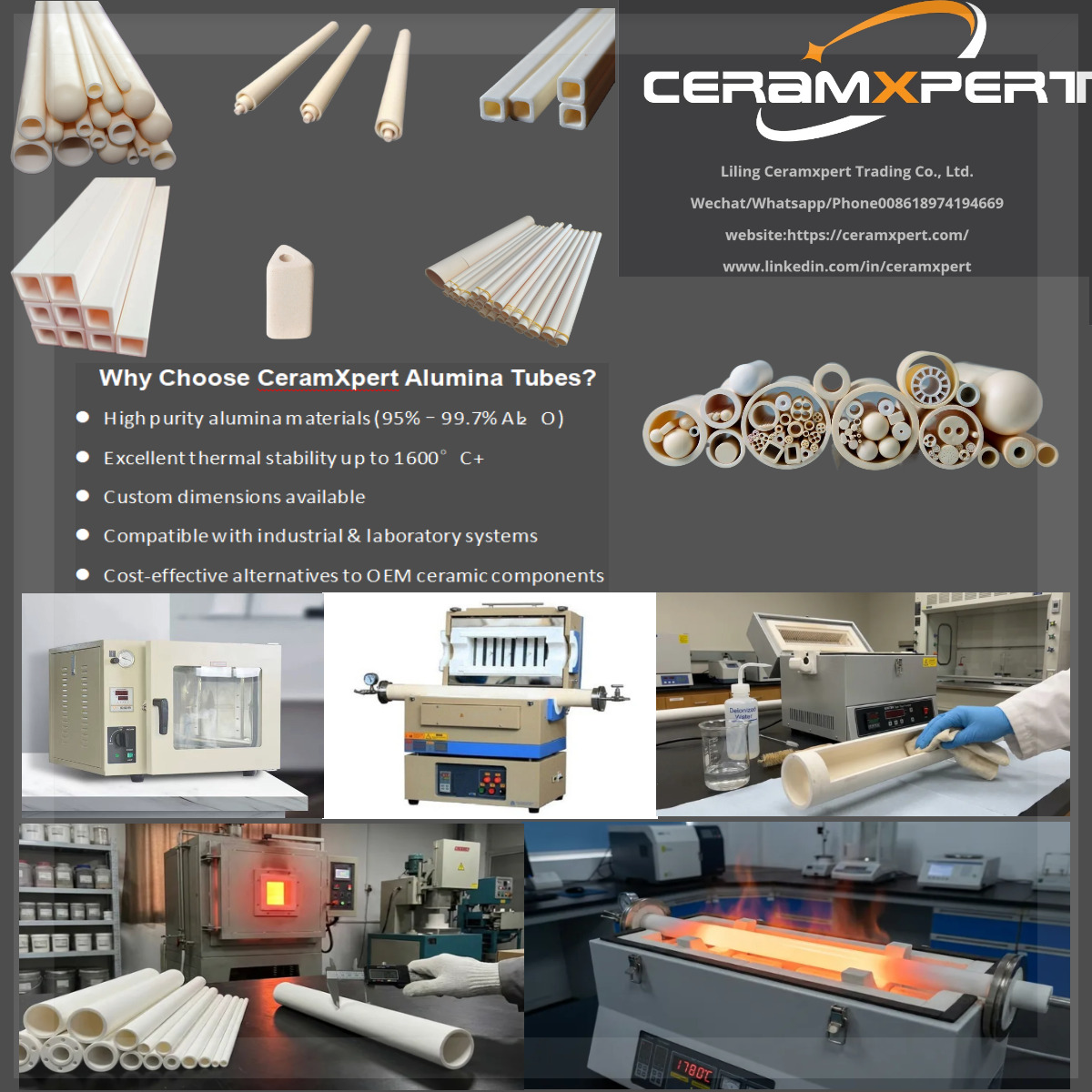
Why Choose CeramXpert Alumina Tubes?
- High purity alumina materials (95%–99.7% Al₂O₃)
- Excellent thermal stability up to 1600°C+
- Custom dimensions available
- Compatible with industrial & laboratory systems
- Cost-effective alternatives to OEM ceramic components
Conclusion
Choosing the right alumina tube is essential for achieving stable thermal performance, long service life, and process reliability. By considering temperature, thermal cycling, application type, and chemical environment, you can significantly improve operational efficiency.
At CeramXpert, we support engineers, researchers, and procurement teams with precision ceramic solutions for advanced thermal and industrial applications.